What glass railing panels are made of, how they're tested, and why thickness matters. Tempered vs laminated, wind load calculations, ASTM E84 testing, and when 6mm isn't enough.
This article is part of our complete Glass Deck Railing guide.
The glass panel is the largest visual surface on your railing and the component that actually has to resist impact, wind load, and decades of weather exposure. People spend weeks choosing post colours and top rail profiles, then accept whatever glass their installer puts in with barely a question. That's backwards.
We've been manufacturing glass railing systems at our facility in Aldergrove, BC for over 20 years. Our panels are independently load-tested by Intertek and our systems are certified by JCJ Design Engineering. Here's what we know about glass selection: the structural options, the aesthetic treatments, and the code requirements that actually matter on a real project.
Tempered glass railing panels
Tempered glass is regular float glass that's been heated to about 620 degrees Celsius and then rapidly cooled. This puts the outer surfaces into compression and the interior into tension, making the finished panel roughly four times stronger than annealed (untreated) glass of the same thickness. When tempered glass does break (which takes considerable force), it fractures into small, relatively harmless granular pieces rather than the large jagged shards that annealed glass produces.
This is what our system is built around. Our standard panels are 6mm tempered glass for Glass Component (framed) systems, tested by Intertek with a 200-pound force applied over one square foot centred on the panel. The glass passed with a factored load capacity of 60 psf, roughly four times the wind pressure it would see in most residential installations. That test was conducted per ICC-ES AC273, which is the acceptance criteria for handrails and guards.
For our Infinity Topless (frameless) system, the glass is thicker: 12 to 13mm. Without a top rail providing structural support, the glass itself has to handle more of the lateral load. Thicker glass costs more to manufacture, more to ship, and more to handle on site, which is one of the reasons frameless glass railing costs more than framed.
The limitation of tempered glass is what happens after it breaks. Because it shatters completely into small pieces, a broken tempered panel leaves an open gap in the guard until it's replaced. For ground-level decks, this is manageable. For elevated balconies, a broken panel at height means glass fragments falling to whatever is below, which is why some jurisdictions now require laminated glass above a certain elevation.
Laminated glass railing panels
Laminated glass is two layers of glass bonded together with a plastic interlayer, typically polyvinyl butyral (PVB) or ethylene-vinyl acetate (EVA). When laminated glass breaks, the interlayer holds the fragments in place. The panel cracks but remains in the frame as a single piece, maintaining its barrier function until it can be replaced. Same technology as car windshields, same reason.
Here's the code shift that matters: starting with the 2015 edition of the International Building Code (IBC), Section 2407, glass infill panels in guards must be laminated glass with a minimum nominal thickness of 1/4 inch. The glass must be both tempered and laminated. There are limited exceptions, but laminated is now the standard for new construction under IBC jurisdictions across most of the United States.
In Canada, the National Building Code doesn't have the same blanket laminated requirement. Tempered glass is still acceptable for most guard applications. However, some municipalities and project specifications require laminated glass on elevated guards, and the trend is moving in that direction.
Laminated glass costs 30 to 50% more than tempered, depending on the size and specification. It's also heavier (two glass layers plus the interlayer), which can affect post spacing calculations and handling during installation. But for any installation above ground level, the safety argument for laminated is hard to dismiss.
Frosted, tinted, and low-iron: the aesthetic options
These are treatments applied to tempered or laminated base glass. They don't change the structural performance. They change how the glass looks and how much you can see through it.
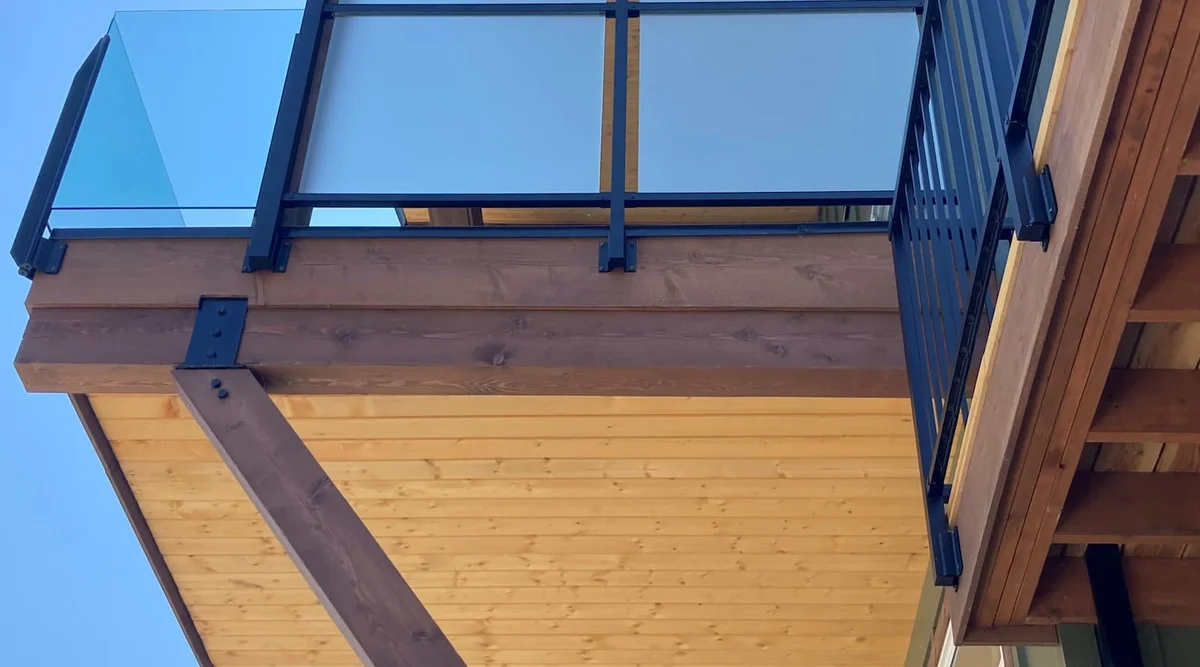
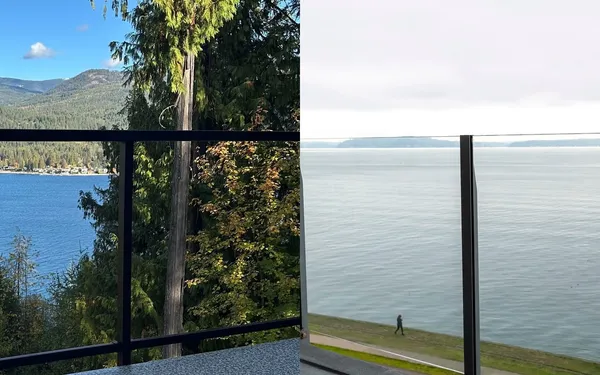
Frosted glass (acid-etched) diffuses light and blocks direct visibility. You get brightness without transparency. This is the most popular option for balcony railing facing neighbours and for pool surrounds where privacy from the street matters. It also shows fingerprints and water spots less than clear glass, which is a practical advantage people appreciate after living with it for a season. The Christina Lake, BC project installed by Grand Forks Deck and Rail uses privacy glass panels on the sections facing the neighbouring property, with clear glass on the viewing side. Same posts, same colour, different glass where it matters.
Tinted glass has metallic oxides added during manufacturing that give it a uniform colour, typically grey, bronze, or green. Tinted panels reduce glare, provide partial privacy (shapes visible but not detail), and complement specific architectural colour schemes. The Metropolis towers in Newark, NJ use tinted glass panels across both buildings, which complement the contemporary architecture while providing partial privacy for the residents on each balcony.
One thing worth knowing about tinted glass: it absorbs more heat than clear glass. Not a structural concern for railing panels, but on a south-facing deck in a hot climate, tinted panels will be noticeably warmer to the touch than clear glass on a sunny day.
Low-iron glass (sometimes called ultra-clear or Starphire) is manufactured with reduced iron content, producing a panel that's more transparent and colour-neutral than standard clear glass. Standard float glass has a slight greenish tint visible at the edge, caused by iron oxide in the raw materials. Low-iron eliminates that. The difference is subtle when looking straight through a panel but obvious when you compare edges side by side. It's a premium option typically specified on high-end residential projects where maximum clarity is the priority.
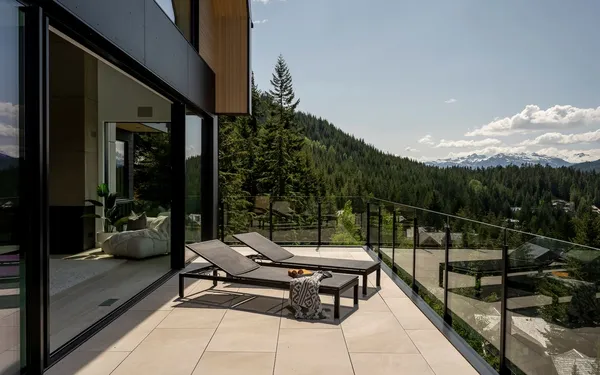
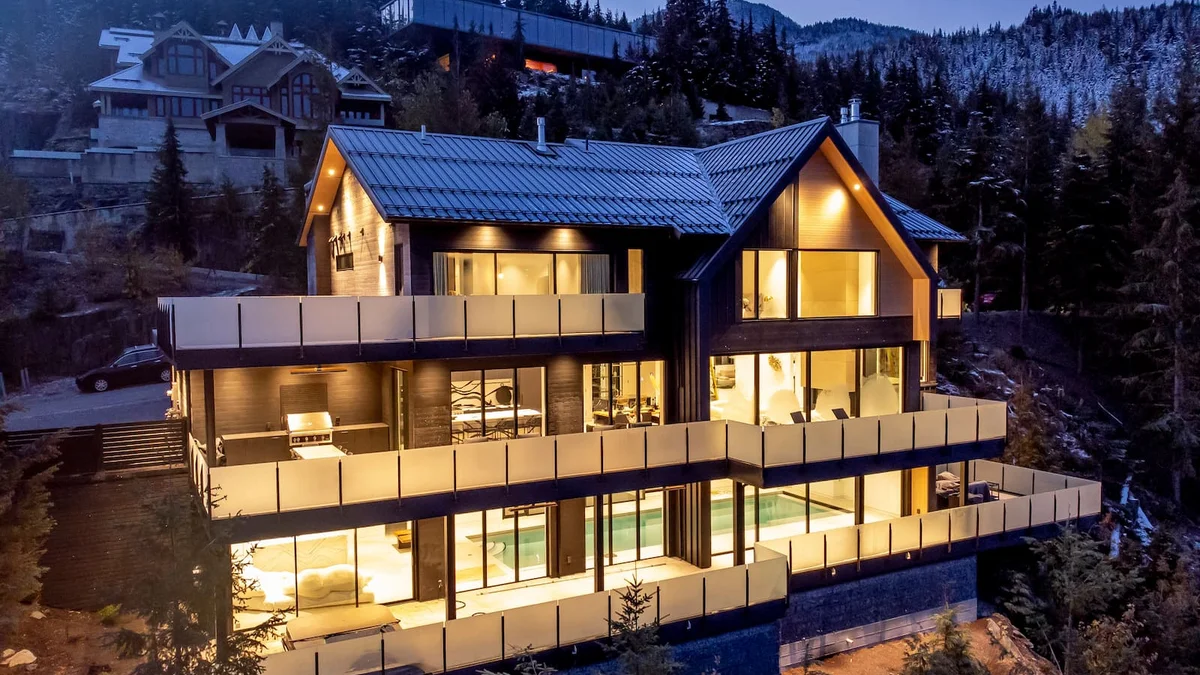
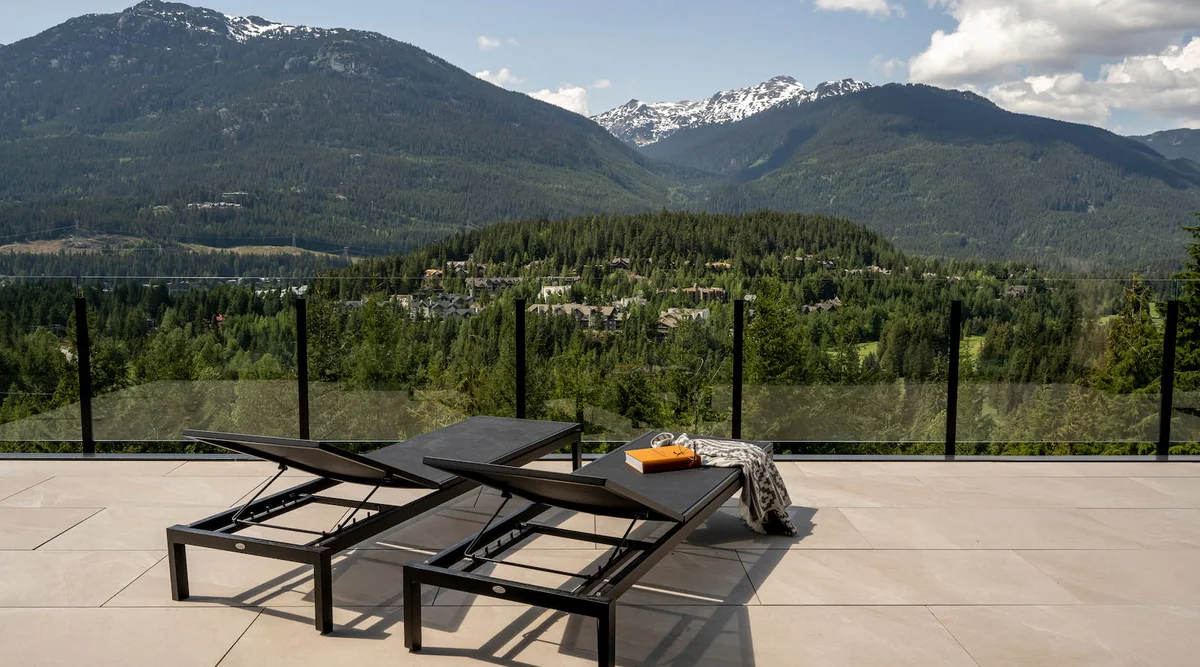
A note from our Whistler, BC project installed by Whistler Glass: the glass panels frost naturally in cold weather because of the temperature differential between the warm interior side and the cold exterior. That's not a coating issue or a defect. It's condensation freezing on the glass surface, and it clears as soon as the temperature rises. The same panels look crystal clear in summer. We mention this because homeowners sometimes see frosted panels in winter photos and think the glass is permanently frosted. It isn't.
What determines glass thickness for railing
You can't just pick a thickness. The required glass thickness depends on the panel size (specifically the unsupported span), the loads it needs to resist, and the safety factor required by code.
Our system uses 6mm tempered glass as the standard for framed (Glass Component) systems. Here's why that number works: with our panel size of approximately 66" x 38" supported on two sides (top and bottom rails), the nonfactored load capacity per ASTM E 1300-09a is 15 psf. With a glass type factor (GTF) of 4.0 for tempered glass, the factored capacity is 60 psf. The actual wind load on the panel in a typical Exposure B installation at 20 feet above ground with 110 mph wind speed is about 15 psf. So the glass has roughly a 4:1 safety margin against wind load in standard conditions.
Where does 6mm become insufficient? High wind areas. Our engineering review shows that the 6mm tempered glass system handles wind pressures up to 25 psf without further analysis. Above that (which occurs in Exposure C and D zones, at higher elevations, or with higher wind speeds), the system needs case-by-case evaluation. In some cases, thicker glass or closer post spacing resolves the issue. In Exposure D areas near the coast, 6mm tempered panels typically don't work and a thicker specification is needed.
For frameless (Infinity Topless) systems, the glass is 12 to 13mm because there's no top rail to share the load. The glass panel itself handles the full lateral force. This is the thickness difference Mike walks our dealers through regularly: "The infill for infinity is thicker, 12 mil or 13 mil" versus the 6mm on framed systems. It's a significant cost and weight difference that directly affects the price gap between framed and frameless.
If you're unsure about your wind exposure classification, your local building department can tell you, or your dealer can reference the wind tables in our engineering documentation.
How glass railing panels are tested
Building codes don't just require glass railing to "be strong enough." There's a specific testing protocol.
The standard is ICC-ES AC273: the Acceptance Criteria for Handrails and Guards. Under this protocol, the glass panel is installed in the actual railing frame (not tested in isolation) and subjected to a concentrated load of 200 pounds applied over a one-square-foot area at the centre of the panel. The panel has to resist this load without failure.
Additionally, IBC Section 2407.1.1 requires glass guards to meet a safety factor of 4.0. This means the tested capacity has to be at least four times the design load. Our 6mm tempered panels meet this with a factored capacity of 60 psf against a typical design load of 15 psf.
Our systems are tested by Intertek, an accredited third-party testing laboratory. The engineering is certified by JCJ Design Engineering for compliance with the National Building Code of Canada 2020 and the US IRC. Every order ships with an engineering certification letter. When your installer hands that letter to the inspector, the conversation is usually short.
Choosing the right glass for your project
For most residential deck projects at ground level, 6mm clear tempered glass in a framed system is the right choice. It's proven, it's cost-effective, and it meets code with a 4:1 safety margin.
Consider upgrading when:
You're above ground level. Laminated glass is increasingly required by code and is worth specifying even when it's not. A broken panel at height is a safety issue that tempered alone doesn't solve.
You want privacy. Frosted or tinted glass. Mixed configurations (clear on the view side, frosted on the neighbour side) are common and cost the same per panel as all-frosted or all-clear.
You're in a high wind zone. Thicker glass, closer post spacing, or both. Your dealer can reference our wind tables to determine the right specification for your location.
You're going frameless. 12 to 13mm tempered is standard for our Infinity Topless system. This is non-negotiable. The glass does the structural work that the top rail would do on a framed system.
Maximum clarity matters. Low-iron glass eliminates the greenish tint of standard float glass. Premium option for high-end view properties.
For the full system comparison: Frameless vs Framed Glass Railing. For pricing: Aluminum Deck Railing Costs in 2026.
Not sure which glass type is right for your project? Find a dealer who can assess your site conditions and recommend the right panel specification, or request a quote.
Frequently asked questions
What type of glass is used in railing systems?
Tempered safety glass is the standard. For framed systems, 6mm tempered. For frameless, 12 to 13mm tempered. Laminated glass (tempered with a plastic interlayer) is required by the IBC for guards in many US jurisdictions and is increasingly specified for elevated installations in Canada. Frosted, tinted, and low-iron are aesthetic options applied to either tempered or laminated base glass.
What is the difference between tempered and laminated glass for railing?
Tempered glass is four times stronger than annealed glass and breaks into small granular pieces. Laminated glass adds a plastic interlayer that holds fragments in place if the panel breaks. Tempered leaves an open gap when broken. Laminated cracks but stays in the frame. For elevated installations, laminated provides a critical safety advantage.
How thick does glass railing need to be?
It depends on the system type and wind exposure. Framed (Glass Component) systems use 6mm tempered glass as standard, which provides a 4:1 safety margin in typical conditions. Frameless (Infinity Topless) systems use 12 to 13mm tempered because the glass handles lateral loads without top rail support. High wind zones may require thicker glass or closer post spacing regardless of system type.
Can you mix clear and frosted glass on the same railing?
Yes. Mixed configurations are common: clear glass on the view side, frosted on the side facing neighbours. Same posts, same top rail, same colour. The glass type is the only thing that changes. This approach is popular on balconies and decks with mixed exposure.
Does tinted glass affect railing strength?
No. Tinting is an aesthetic treatment applied during glass manufacturing. It doesn't change the structural performance of tempered or laminated glass. Tinted glass absorbs slightly more heat than clear glass but this has no structural impact on railing panels.
Is laminated glass required by code for deck railing?
In many US jurisdictions, yes. IBC Section 2407 (starting with the 2015 edition) requires glass infill in guards to be both tempered and laminated. In Canada, the National Building Code doesn't have a blanket laminated requirement for most guard applications, but some municipalities and project specifications require it on elevated guards. The trend across both countries is toward laminated.