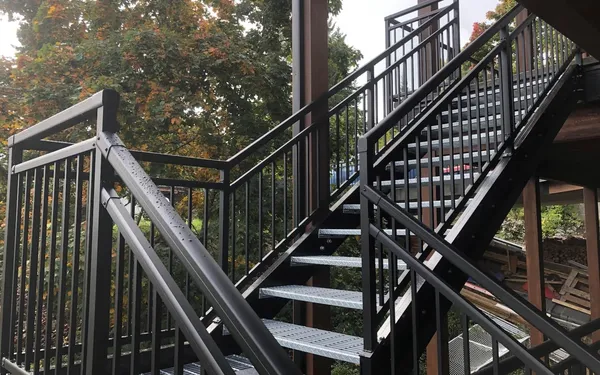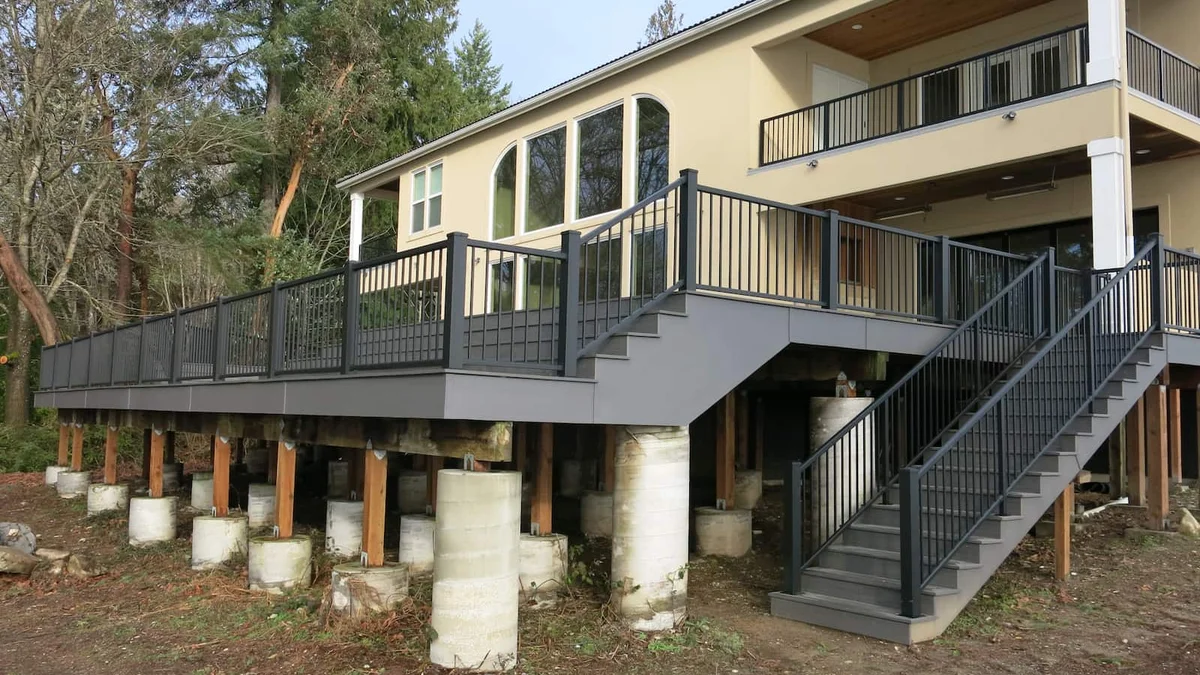
Every component in an aluminum deck railing system explained. Posts, top rails, base plates, brackets, pickets, glass inserts, sleeve posts, and connection hardware.
This article is part of our complete Aluminum Deck Railing guide.
Walk into any big-box store and you'll find deck railing kits stacked on pallets. A box of parts with vague instructions and hardware that may or may not hold up to your local building code. That approach works for a garden border. It doesn't work for something that's supposed to stop a person from falling off a second-story deck.
Aluminum deck railing is a system of engineered components. Each part has a specific job, and how those parts connect to each other determines whether your railing passes inspection, handles the loads your building code demands, and still looks good 25 years from now. We've been manufacturing these systems at our facility in Aldergrove, BC since 2004, and we've refined the engineering on every component over that time. This guide breaks down every part in the system, what it does, what it's made of, and what actually matters when you're specifying railing for a real project.
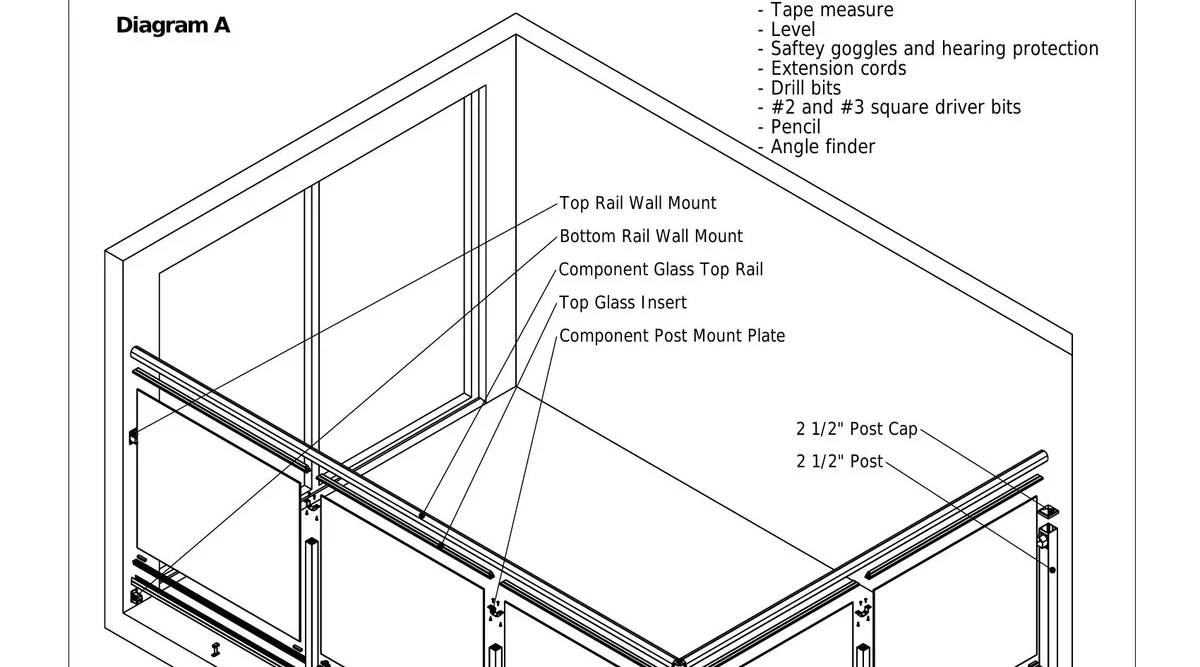
Every component in an aluminum glass railing system. Picket railing uses the same structural frame. The infill between the top and bottom rails is the only difference.
Parts of a deck railing: how the system fits together
Whether you're looking at glass panel railing or aluminum picket railing, the structural frame is the same. A continuous top rail runs over a series of posts. A bottom rail connects the post bases with a small clearance above the deck surface. Infill material (either tempered glass or pickets) spans between those two rails. And posts attach to the deck through base plates or fascia brackets.
That sounds simple, but the engineering lives in the details of each connection. Here's how the load path actually works: when someone leans against your railing, force travels from the top rail into the nearest posts, down through the base plate or bracket connection, and into your deck structure. Every component in that chain has to handle the load. A railing is only as strong as its weakest link, and in our experience, the weakest link is almost always the connection to the deck, not the railing itself.
The parts break down into three categories. Structural components (posts, top rail, bottom rail) carry the loads your building code requires. Infill (tempered glass or aluminum pickets) prevents passage between the rails. And connection hardware (base plates, post mount plates, rail clips, wall mounts, brackets, support legs, and fasteners) ties everything together and anchors the system to the building. Most people spend their time thinking about the first two categories and barely consider the third. That's a mistake.
Want to see how all these components fit together on your specific deck layout? Try our 3D Railing Designer to build and visualize the system before you order.
Deck railing posts: the hardest-working part of the system
Posts do more structural work than anything else in your railing. They're cantilevered (fixed at the base and free at the top), which means every pound of horizontal force at the top rail gets multiplied into a much larger bending moment at the base. A person leaning against a 42-inch-tall post creates serious stress at that base connection, which is why post material, wall thickness, and mounting hardware matter more than most people realize.
What the posts are made of
Not all aluminum is the same. There are dozens of alloys and temper designations, and the one your post is extruded from directly affects how much force it can handle. Our posts use 6005-T61 aluminum, a structural alloy with a tensile yield strength of 241 MPa (about 35,000 psi). For context, that's roughly 40% stronger than the 6063-T6 alloy you'll find in window frames and architectural trim. The T61 temper means the material has been solution heat-treated and artificially aged for maximum strength.
Why does this matter to you? Because a post's load capacity comes from the combination of its material strength and its cross-section geometry. A post made from a weaker alloy needs thicker walls to carry the same load, which means more weight and more material cost. A stronger alloy lets you use a more efficient cross-section.
Regular wall vs heavy wall posts
We manufacture two post extrusions from the same 1.72-inch square profile. The regular wall post has a wall thickness of 0.070 inches. The heavy wall post is 0.235 inches thick, more than three times the wall of the standard post. Both are the same exterior dimension, so they use the same brackets, base plates, and rail connections.
In load testing conducted by Intertek, the regular wall post handled 315 pounds applied at the top before reaching its limit. The heavy wall post handled 555 pounds, a 76% increase in capacity. That extra capacity shows up in the post spacing tables: heavy wall posts can be spaced further apart, which means fewer posts, fewer base connections, and a cleaner look for the same structural performance.
When do you actually need heavy wall posts? Three scenarios come up most often: wide post spacing on long runs where you want to minimize the number of posts, high wind exposure where lateral pressure on glass infill adds to the code loads, and taller-than-standard guards where the increased lever arm puts more stress on the base connection.
Post types by position
Beyond wall thickness, posts are configured differently depending on where they sit in the run. End posts terminate a railing section and have bottom rail connections on one side only. Mid posts (also called intermediate posts) sit between two sections with connections on both sides. Corner posts (90-degree) join two perpendicular railing runs. Each type uses the same extrusion. The difference is in how the bottom sleeves or rail clips are installed.
Sleeve posts: where railing sections connect
This is the component category that most articles about deck railing components skip entirely, and it's one of the most important for understanding how a railing system actually goes together in the field.
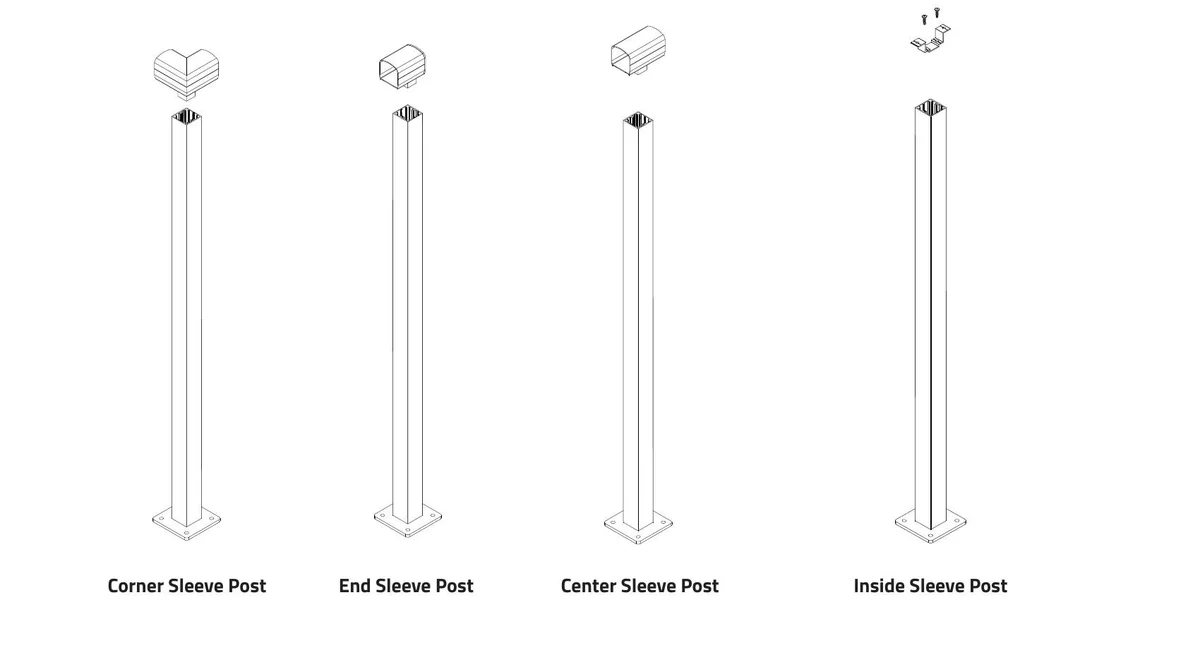
Sleeve posts are the posts at transition points: corners, stair-to-deck connections, section joins, and anywhere two runs of railing meet. They're called "sleeve posts" because they receive a sleeve at the top that connects the rail sections from both sides. The sleeve post is the first thing an installer locates during layout because every other measurement flows from the sleeve post positions.
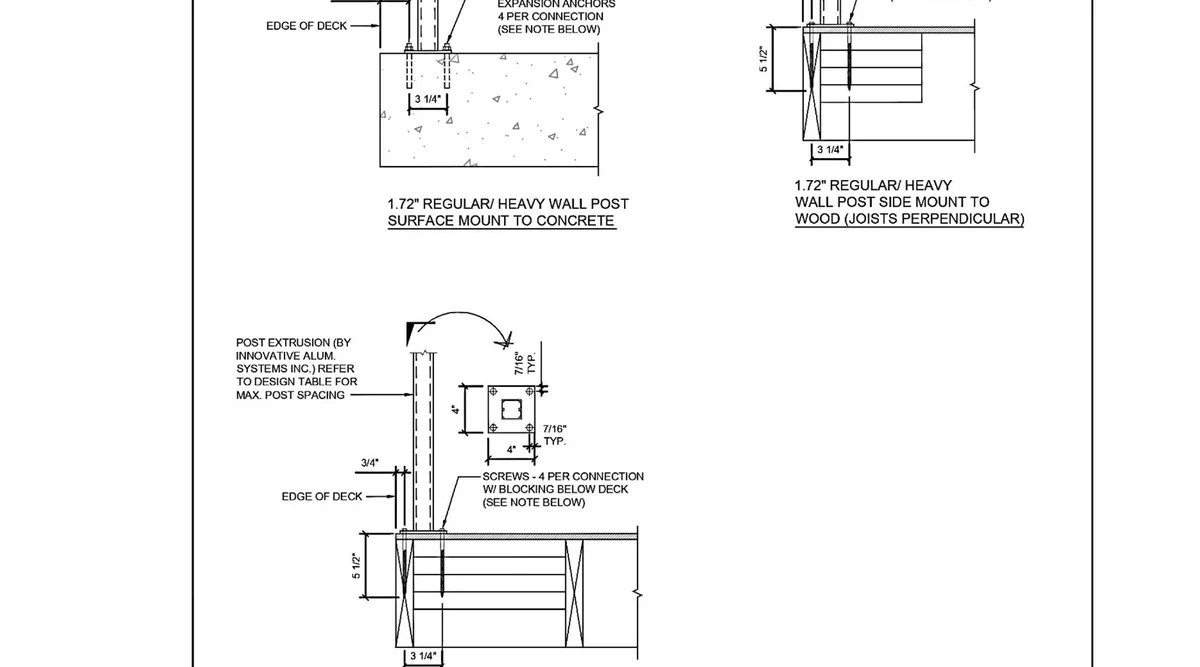
We use four configurations:
Corner sleeve post. Sits at a 90-degree angle change. Receives a 90-degree sleeve at the top that connects two perpendicular rail sections. The sleeve has a 1-inch mount and is secured with #10 x 3/4" tek screws on each side.
End sleeve post. Terminates a railing section at a freestanding end. The end sleeve drops into the top of the post and captures the rail from one side. We use end sleeves at the top of stairs so there's nothing protruding that could catch someone as they use the stair.
Center sleeve post. Joins two in-line railing sections when a single run is longer than the manufactured rail length. The center sleeve sits on top of the post and receives rail from both sides, allowing sections to be spliced together for runs longer than 20 feet.
Inside sleeve post. Used to extend railing runs beyond 20 feet by splicing top rail sections end-to-end inside a continuous sleeve. The splice has to be centered over the post location, and a glass/Flex Rail post mount plate gets installed on top with #10 x 3/4" tek screws.
The sleeve post at the top of a stair section is doing double duty. It's anchoring both the level deck railing and the stair railing at different heights and different angles. Inspectors know this is a structural stress point and check it specifically. Our installation guides walk through the sleeve post layout as the very first step because getting these positions right determines everything else about the installation.
Termination options: how railing ends
Every railing run has two ends, and there are several ways to finish them. The termination method affects both the look and the structural behaviour of the system.
Wall mount (restrained). The top rail connects to the building through a wall mount bracket secured with #12 x 1-1/2" screws into solid framing (not just siding). This is the strongest termination because the wall provides a fixed support point. When both ends of a run are wall-mounted, the entire system is "restrained," which qualifies for wider post spacing in our engineering tables because the wall connections help distribute the load.
Inside sleeve (restrained). An alternative to wall mounting where the rail slides over an inside sleeve that's bolted to the wall or column. Clean look, very rigid connection. Secured with #14 x 3" screws into the structure.
End cap (freestanding). The top rail extends past the last post, and an end cap screws onto the painted end with #8 x 1-1/4" screws. Simple and common on residential decks.
End sleeve (freestanding). An over-sleeve style termination that drops into the end post. The top rail slides inside the end sleeve, creating a clean flush finish tight to the post. Slightly more expensive than an end cap, but it looks sharper and is what we use at the top of stairs to avoid any protrusion.
2.5-inch post termination. For designs that call for a larger post at the end of a run, the railing can terminate into a solid 2.5-inch post with a pyramid cap. This is a design choice more than a structural one. It adds visual weight at the endpoints.
Surface mount vs fascia mount: two ways to attach posts to the deck
This is one of the biggest decisions in any railing project, and it affects everything from the look of the finished installation to the structural requirements of your deck framing.
Surface mount (top mount) posts sit on top of the deck surface. The post connects to a 4-inch by 4-inch base plate that's 3/8-inch thick, extruded from 6061-T6 aluminum. Four anchor bolts go through the base plate and into the deck structure below. For concrete, those are typically 3/8-inch Hilti Kwik Bolt expansion anchors. For wood framing, they're structural screws into solid blocking, not just through the decking boards. The decking alone won't hold.
Fascia mount (side mount) posts attach to the side of the deck structure using a 5-inch-tall fascia bracket. This puts the entire railing outboard of the deck surface, which gives you full use of the deck area right up to the edge. The trade-off is that all the load goes into the fascia board and the framing behind it, so you need solid backing: a rim joist or 3-ply 2x10 blocking at minimum. Fascia mounting into plywood alone is a code violation waiting to happen.
Which one should you use? Surface mount is more forgiving structurally because the base plate distributes force across a larger area and the anchors resist in tension (pulling straight up), which is a reliable load path. Fascia mount looks cleaner and gives you more deck space, but the anchors are loaded in shear and tension simultaneously, and the backing structure has to be specifically designed to handle it. If your deck framing wasn't built with fascia-mounted railing in mind, surface mount is the safer bet.
We've seen both methods work well across thousands of installations. The Seattle multi-family project we supplied used fascia-mounted infinity with custom base plates welded to prepared steel in the concrete. That's the high end of fascia mount complexity. A typical residential surface mount installation in Bellingham, WA or Powell River, BC is straightforward for any experienced installer. Talk to your dealer about what your specific deck structure can support.
How far apart should deck railing posts be?
This is one of the most common questions we get, and the answer isn't a single number. Maximum deck railing post spacing depends on the post type (regular or heavy wall), the mounting method (surface or fascia), whether the top rail ends are freestanding or connected to the building, and how many posts are in the run.
Here are the general ranges for our system at standard 42-inch guard height with code-required loads under the National Building Code of Canada and IBC:
Surface mount, regular wall posts: maximum spacing ranges from 7'6" for a single-span freestanding section down to about 3'10" for longer runs with 7+ posts. When the top rail is restrained (connected to the building at one or both ends), spacing increases. A two-post restrained section can hit 7'2" per span.
Surface mount, heavy wall posts interspersed with regular wall: spacing jumps significantly. A two-post freestanding section can reach 7'1" per span, and longer runs with heavy wall corner posts can maintain 6'0" spacing even with 7+ posts.
Fascia mount, regular wall posts: slightly tighter spacing than surface mount due to the different load path. A single freestanding section maxes out at 7'6", and longer runs settle around 3'6" per span.
These numbers come from our engineering design manual, based on structural analysis per CSA S157 and Intertek load test results. They're certified by JCJ Design Engineering for compliance with the 2020 National Building Code of Canada and the 2024 BC Building Code, among others. If your local jurisdiction uses different load requirements, or if you're dealing with high winds on glass infill panels, the spacing needs to be adjusted. We publish wind adjustment tables for exactly that scenario.
The point is that post spacing isn't something to guess at. It's engineered, and it varies by configuration. Your dealer can look at your deck layout, pull from these tables, and give you the exact post count and placement.
Aluminum balusters and pickets
Deck railing balusters (also called pickets or spindles) are the vertical infill elements that fill the space between the top and bottom rail. In aluminum railing, they're typically 5/8-inch square bars extruded from 6061-T6 aluminum. That alloy designation matters: 6061-T6 has a yield strength of 240 MPa (about 34,800 psi), which means each individual picket can handle the 0.5 kN (112 lbs) concentrated load that building codes require on any individual guard element.
Deck railing spindle spacing is governed by the 4-inch sphere rule. No opening in the guard can allow a 4-inch sphere to pass through. In practice, this means baluster spacing (measured from inside edge to inside edge) has to be less than 4 inches. For 5/8-inch square pickets, a center-to-center spacing of about 4-5/8 inches gives you the maximum allowable gap. Go tighter for a denser look. It's an aesthetic choice as long as you stay within code limits.
Our system uses two picket configurations:
Welded picket panels have the pickets factory-welded to the top and bottom rails, creating a rigid one-piece panel that slides into place between posts. The spacing is set at the factory and is code-compliant before the system ever leaves Aldergrove. There's no field measurement or guesswork. The trade-off is that you can't adjust picket position in the field, so the installer has to manage where mid posts land relative to the picket array.
Flex Rail insert pickets use a punched bottom rail and a top rail insert channel. Individual pickets snap into pre-punched holes, which makes field adjustments easier and allows for panel replacement without welding. The Flex Rail system also solves the post-alignment problem: because pickets are individual inserts rather than a continuous welded array, the installer can place posts wherever the layout requires without worrying about a picket landing too close to a post. This is why Flex Rail is the preferred system for concrete replacement projects and multi-family installations where post locations are dictated by existing conditions. The multi-family project in Gibsons, BC, installed by Sun Pro Enterprises, used Flex Rail for exactly this reason.
If you're choosing between glass and pickets for your infill, take a look at our design ideas guide to compare the look and the cost difference.
Top rails and bottom rails
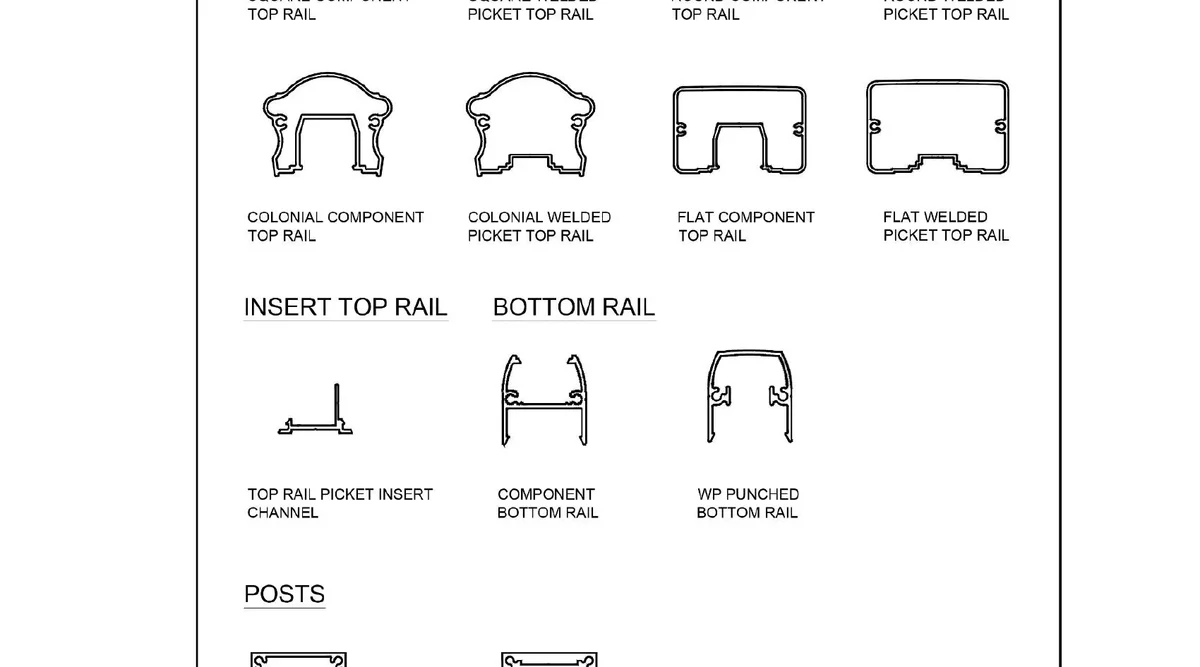
Top rail profiles
The deck railing top rail runs continuously over the posts and is the part people actually touch and lean on. It needs to be comfortable to grip, stiff enough to transfer loads between posts without excessive deflection, and compatible with whatever infill you're using. Our top rails are extruded from 6063-T6 aluminum, a different alloy than the posts, selected for its excellent extrudability and surface finish while still providing plenty of strength for the bending loads a top rail experiences.
We offer four profiles: square, round, colonial, and flat. Each is available in both glass-infill and picket-infill versions. The channel geometry on the underside differs to accommodate different infill attachment methods. The glass-infill top rail has a wider, deeper recess that accepts the glass insert and provides the channel for the Flex Rail picket system. The picket-infill top rail has a narrower, shallower profile because there's no recess needed for glass or insert panels.
This is a detail Mike walks our dealers through regularly: the glass/Flex Rail top rail and the regular picket top rail are different extrusions. A stocking dealer who commits to Flex Rail can use the same top rail for both their glass and their Flex Rail picket installations, which simplifies inventory. They can carry two or three top rail profiles (say, square and flat) and use them across both product lines.
In load testing, the top rail carried 500 pounds at midspan on a 72-inch simple span. That's well above what building codes require and gives the system significant reserve capacity for distributing loads across multiple posts.
Profile choice matters for code as well as aesthetics. Some municipalities require stair handrails to be "graspable," which means your hand has to be able to wrap around the profile. Round and colonial profiles meet this requirement. Flat top typically does not and may require a separate applied handrail on stairs. The Powell River, BC project by Modern Powell River is a good example: they used flat top on the level deck and colonial on the stairs because the local building department required a graspable profile on the stair guards.
Bottom rails
The bottom rail connects the post bases, carries the weight of the infill, and maintains the clearance gap above the deck surface. For glass infill, the bottom rail has a channel that holds the bottom glass insert and setting blocks. For picket infill, the bottom rail is either a smooth component rail (used with Flex Rail insert pickets) or a WP punched rail with pre-punched holes for welded panels.
A support leg clips into the bottom rail midway between posts to prevent sagging under the weight of the glass or pickets. The support leg also fastens to the deck surface, adding a third point of attachment between the railing system and the structure.
Glass infill: how glass panels are installed and held in place
For glass component and Infinity Topless systems, the infill is tempered glass. Understanding how the glass sits in the frame matters because it explains why glass railing costs more than picket and why installation precision is critical.
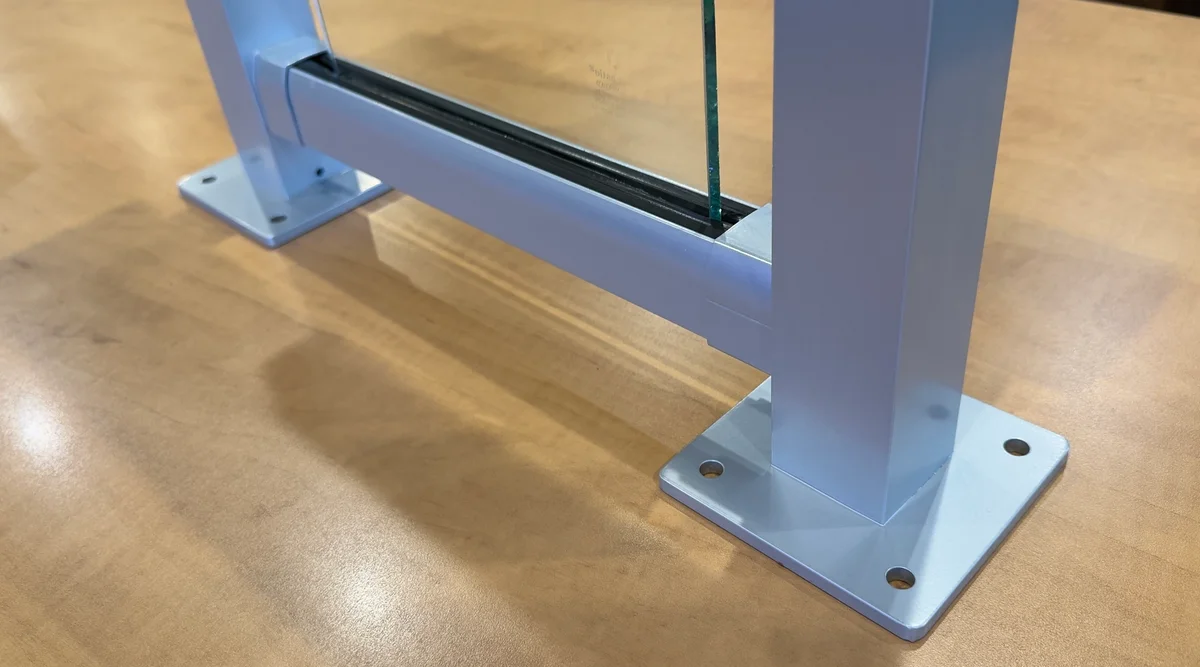
The glass panel gets lifted into the frame from above. There's enough vertical play at the top of the channel so you can push the panel up high enough to clear the bottom rail, then drop it down into position. The panel sits on rubber setting blocks at the bottom that support the glass weight and keep it centered in the channel. Once seated, the glass is captured at the top and bottom by the rail channels and held in position by the gaskets.
The vertical play at the top is an installation feature, not a gap. It's inside the frame, not an exposed opening, so it doesn't create a code issue. The setting blocks at the bottom are the wear item: they support the full weight of the glass panel and are the component most likely to need replacement over the life of the system (typically 15 to 20 years depending on UV exposure).
Our systems use 6mm tempered glass tested per AC273 with a safety factor of 4.0. The glass itself is virtually permanent. It doesn't degrade from weather exposure. The rubber gaskets and setting blocks are what age. Replacing setting blocks is standard maintenance after two decades, not a structural failure of the system.
Deck railing brackets, base plates, and connection hardware
This is the category where quality differences between railing manufacturers become most obvious. You can have the strongest posts and the stiffest top rail on the market, and it means nothing if the connection hardware can't transfer the load.
Base plates are 4" x 4" x 3/8" thick, extruded from 6061-T6 aluminum. The post connects to the base plate through 4 corner screws (#14) and 2 mid-face screws (#10), creating a rigid connection that transfers the full bending capacity of the post into the base. The base plate then bolts to the deck structure with four 3/8-inch anchor bolts. Each anchor has to resist up to 1,890 pounds of tension on a regular wall post, and up to 3,330 pounds on a heavy wall post. That's why the backing structure under your deck surface matters. Those loads go straight into whatever the bolts are biting into.
Post mount plates are small aluminum plates that screw to the top of posts using #10 x 3/4" tek screws, creating the connection point for the top rail. Any post that doesn't get a top sleeve needs a post mount plate. The glass/Flex Rail post mount plate is taller than the regular picket version because it goes up inside the deeper recess of the glass top rail. This is a detail that matters during ordering: if you're mixing systems or switching between glass and picket on the same project, you need the right mount plate for each section.
Deck railing brackets (rail clips and bottom wall mounts) attach to the posts and hold the bottom rail in position. Rail clips are screwed on with #10 x 1-1/2" stainless steel screws. Bottom wall mounts are the alternative for wall-terminated ends. Getting the screw chase alignment right during installation is critical. If the clips aren't aligned with the rail direction, the bottom rail won't seat properly and you'll be redoing the work.
Top sleeves (90-degree) are round aluminum sleeves that cap the top of corner posts where two perpendicular rail sections meet. The sleeve covers the joint and creates a smooth transition. Posts receiving a top sleeve get trimmed 1/8 inch shorter than posts with mount plates to keep the finished rail height consistent across the entire run.
Wall mount brackets are used wherever the rail terminates into a building wall instead of a post. They bolt to the wall structure (not just the siding) and provide a fixed end condition for the rail.
Fascia brackets are 5-inch-tall L-shaped brackets for side-mount installations. Each bracket uses four bolts into the framing and connects to the post through the same screw pattern as the base plate.
All connection hardware is powder coated to match the posts and rails. Every piece goes through the same 5-stage pretreatment and AAMA 2604 coating process. The finished installation looks like one continuous system rather than a collection of parts bolted together.
Deck railing kits vs engineered component systems
If you search for "deck railing kits," you'll find products ranging from $20 to $80 per foot. They come in a box, usually with basic assembly instructions, and they're designed to be installed by a homeowner with a drill and a level.
Engineered component systems are a different category. Here's what separates them:
Engineering certification. Our systems come with a JCJ Design Engineering certification letter confirming compliance with the National Building Code of Canada 2020, BCBC 2024, and the US IRC. A kit from a hardware store comes with assembly instructions. When an inspector shows up, the engineering letter ends the conversation. The assembly instructions don't.
Load-tested components. Every structural component in our system has been tested by Intertek, an accredited third-party lab. Posts tested to 315 and 555 lbs. Top rails tested to 500 lbs at midspan. Base plates tested for anchor tension loads up to 3,330 lbs. Kit manufacturers don't publish these numbers because they haven't done the testing.
In-house coating. Our powder coating is done in-house with a 5-stage pretreatment and AAMA 2604 powder from Tiger Drylac and AkzoNobel. Both suppliers audit our line annually. Kit manufacturers outsource coating and don't control the pretreatment quality.
Dealer support. When a project has unusual conditions (concrete mounting, wide post spacing, high wind, non-standard heights), our dealers can call our engineering team and get answers. A kit is a kit. If it doesn't fit your situation, you're on your own.
The price difference between a kit and an engineered system is real. A kit might save you $20 to $40 per foot upfront. But if the kit fails inspection, doesn't handle the load, or starts deteriorating in 3 to 5 years because the coating wasn't properly applied, the cost of removal and replacement exceeds what you saved. For a deeper look at pricing: Aluminum Deck Railing Costs in 2026.
Ready to spec the right components for your project? Find a dealer or get a quote. Our engineering team can help with post spacing calculations, mounting method recommendations, and wind load adjustments for your specific site.
Frequently asked questions
What are the parts of a deck railing called?
The main parts are: posts (vertical structural members bolted to the deck), top rail (horizontal rail running over the posts), bottom rail (horizontal rail connecting post bases), infill (pickets or glass panels between the rails), base plates (mounting hardware connecting posts to the deck), and sleeves (connection pieces at corners and section joins). Connection hardware includes post mount plates, rail clips, wall mounts, support legs, and fasteners.
How far apart should deck railing posts be?
Post spacing depends on the post type, wall thickness, mounting method, and how many posts are in the run. For our systems, regular wall surface-mount posts can span up to 7'6" on a single freestanding section. Heavy wall posts with regular wall mid-posts can maintain 6'0" spacing on longer runs. These numbers are engineered and certified, not rules of thumb. Your dealer can calculate the exact spacing for your layout.
What is the difference between surface mount and fascia mount railing?
Surface mount posts sit on top of the deck surface with a base plate bolted through the decking into the framing below. Fascia mount posts attach to the side of the deck frame with brackets. Surface mount is more forgiving structurally. Fascia mount gives you more usable deck space but requires solid backing (rim joist or 3-ply blocking). The choice depends on your deck structure and your aesthetic preference.
What is a sleeve post on a railing?
A sleeve post is a post at a transition point: corners, stair-to-deck connections, section joins, and ends. It receives a sleeve at the top that connects rail sections from both sides. Sleeve posts are the first components located during installation layout because every other measurement flows from their positions. There are four types: corner, end, center, and inside sleeve.
What is the difference between welded picket panels and Flex Rail?
Welded panels have pickets factory-welded to the rails, creating a rigid one-piece unit. Spacing is set at the factory and is code-compliant out of the box. Flex Rail uses individual insert pickets that snap into pre-punched holes, allowing field adjustment and easier replacement. Flex Rail is preferred for concrete replacement projects and multi-family installations where post locations are dictated by existing conditions.
Do aluminum deck railing kits meet building code?
Some do, many don't. The difference is whether the kit comes with engineering certification from a licensed engineering firm. Our systems ship with a JCJ Design Engineering letter confirming compliance with the NBC 2020, BCBC 2024, and the US IRC. Big-box railing kits typically don't come with engineering documentation, which means the burden of proof falls on the installer and the inspector during the building inspection.