Glass stair railing explained honestly. Why glass component works on stairs, why frameless is rare, what it costs, the code requirements that change everything.
This article is part of our complete Glass Deck Railing guide.
Looking for aluminum picket or Flex Rail stair railing? See our Deck Stair Railing Guide.
Glass stair railing is the question we get asked about the most and the system we install the least. Everyone loves the idea of glass on stairs. The transparency, the light, the seamless look when your level deck has glass and the stairs continue it down to ground level. But glass on stairs is a fundamentally different proposition than glass on a flat deck, and the cost, complexity, and code requirements reflect that.
We manufacture both glass stair railing systems at our facility in Aldergrove, BC: Glass Component (framed) and Infinity Topless (frameless). Both work on stairs. But one of them works well and the other works technically. That distinction matters, and this article explains why.
Why glass on stairs is different from glass on a deck
On a level deck, glass railing is straightforward. Posts go in plumb. The top and bottom rails run level. Glass panels are a standard size that can be inventoried. The installer builds a frame, drops the glass in, and moves on.
On stairs, every one of those assumptions breaks. The rails follow the stair pitch. The posts sit on angled treads and need angle-cut tops. Every glass panel has to be custom-sized to fit the specific angle and span of that particular stair section. There are no standard stair glass panels. Unlike level deck sections where staircase glass railings can use standardized panel sizes, each stair panel is measured on site after the frame is built, fabricated to the exact dimensions, and installed on a second visit.
That two-visit process is the core reason glass stair railing costs more than glass on a flat deck. Visit one: install posts, rails, and frame. Measure the openings precisely. Visit two (after the glass is fabricated): come back and set the panels. The gap between visits depends on glass fabrication lead time, which can be 2 to 4 weeks.
On top of the custom fabrication, the building code requirements on stairs are stricter than on a level deck. The height is measured from the stair nosing (not the tread surface), the 6-inch sphere rule applies at the triangle between the bottom rail and each tread, and many municipalities require the stair handrail to be graspable. That last requirement is where glass stair railing gets complicated, because frameless systems have no top rail to grab.
Glass component railing on stairs: the system that works
Glass component (framed) railing is the glass stair system we recommend for exterior residential stairs. The aluminum top rail and posts provide the structural frame. Tempered glass panels sit in channels within that frame. The top rail gives the installer alignment reference points on the angled surface, and the frame provides structural rigidity that glass alone doesn't offer on a stair pitch.
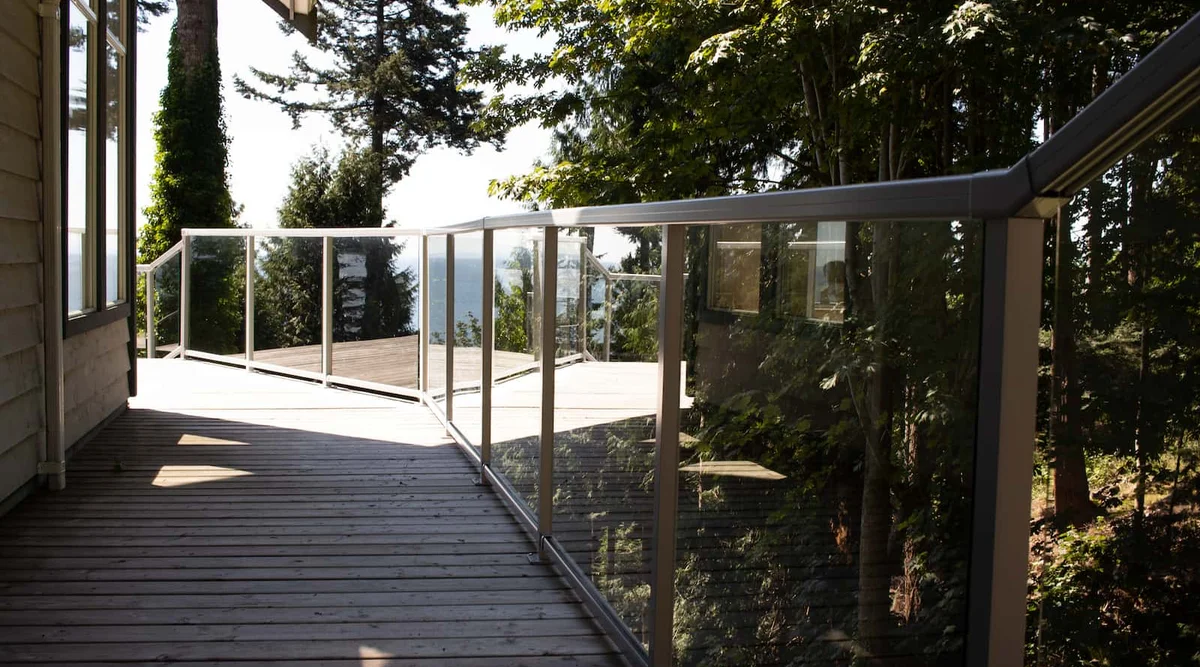
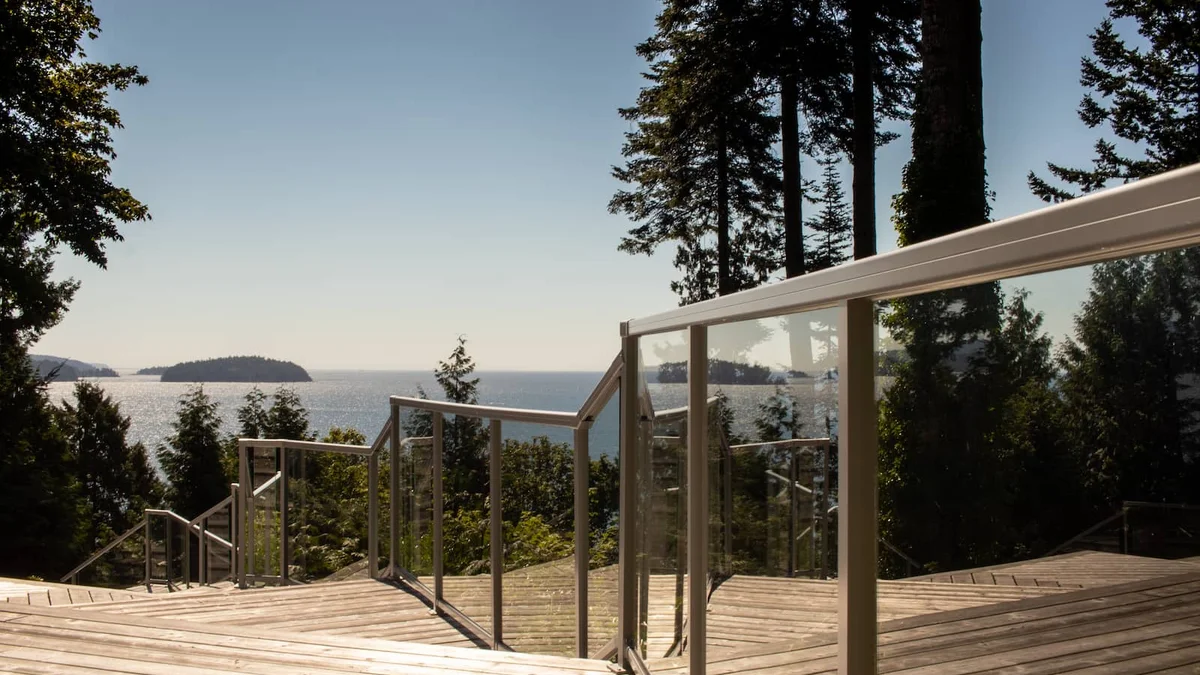
The Gibsons, BC project on the Sunshine Coast, installed by Sun Pro Enterprises, shows glass component railing on a multi-level residential deck with stair transitions. The top rail runs continuously down the stair section, the glass panels follow the pitch, and the framed system handles the angle changes at each transition cleanly. This is what glass stair railing looks like when it's done right: the glass opens up the stairway visually while the aluminum frame does the structural work.
Here's how the installation works on stairs specifically:
The frame goes in first. Posts are set on the stair treads (surface mount) or the stair stringer (fascia mount). The top rail and bottom rail connect the posts, following the stair angle. All sleeve posts, mount plates, and wall mounts are secured and confirmed tight before any glass is introduced.
Setting blocks go into the bottom rail. Two rubber setting blocks per panel, positioned about 4 to 6 inches from each edge. These support the glass panel's weight and keep it centred in the channel. This has to happen during bottom rail prep, before the rail is installed, because getting setting blocks in after the frame is assembled is much harder. The setting blocks are the wear item in the system, typically lasting 15 to 20 years before needing replacement. Replacing them is standard maintenance, not a system failure.
Glass panels are measured after the frame is built. Each stair glass panel has to match the exact opening between posts at the exact angle of the stair section. The installer measures on site, sends the dimensions to the glass fabricator, and the panels are cut to spec. This is why stair glass is custom and can't be pulled from inventory.
Glass goes in last. Each panel is lifted up into the top glass insert (there's enough vertical play to clear the bottom rail), swung over the bottom rail, and dropped down onto the setting blocks. The glass is captured top and bottom by the rail channels. If the glass won't clear the bottom rail, temporarily loosening the top rail mount plates gives enough lift to slide it in.
The result, when the frame is square and the glass is properly seated, is a stairway that feels open and bright. On narrow deck stairs, picket railing can make the stairway feel enclosed. Glass opens it up. Light passes through. The view from inside the house extends down the stairs instead of hitting a wall of vertical pickets.
Why the top rail matters more on stairs
On a level deck, the top rail's primary job is connecting posts and distributing lateral loads. On stairs, the top rail also serves as a handrail. Someone going up or down the stairs needs something to grab for stability.
Many municipalities require stair handrails to be "graspable," meaning your hand can wrap around the profile. Our round and colonial top rail profiles meet this requirement in most jurisdictions. Square is borderline depending on local interpretation. Flat top typically does not qualify.
With glass component railing, the top rail is already there. Choosing a round or colonial profile on the stair section satisfies the graspability requirement without adding any components. This is one of the biggest practical advantages glass component has over frameless on stairs: the code compliance is built into the system.
Frameless glass stair railing: why it's rare
Frameless (topless) glass stair railing exists. We can build it. But we want to be straightforward about what's involved, because the reality is different from what most people picture when they imagine frameless glass flowing down their staircase.
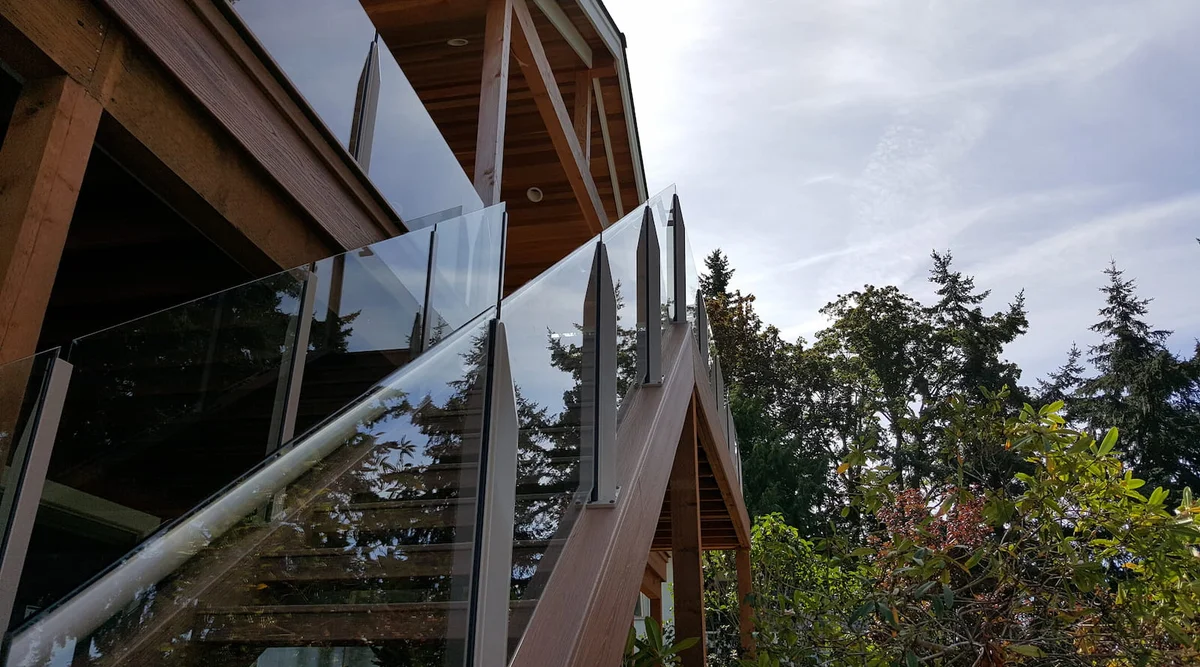
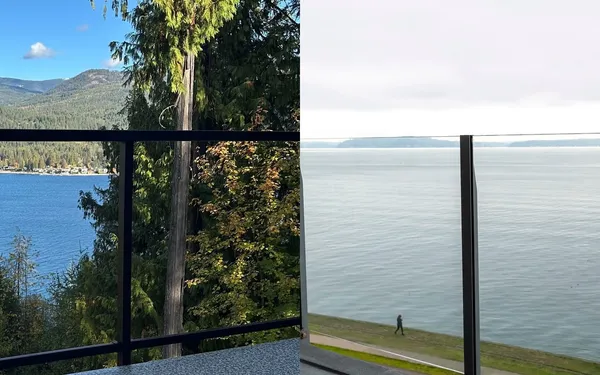
The Whidbey Island project shows frameless infinity glass installed on exterior stairs. It looks dramatic. But look closely and you'll see the applied pipe handrail bolted to the posts alongside the glass. That pipe rail is there because the building code requires something graspable on stairs, and frameless glass has no top rail. The pipe handrail is the solution, but it adds cost, adds visual complexity, and partially undermines the "invisible railing" aesthetic that frameless is supposed to deliver.
Here's why frameless on stairs is uncommon:
The graspability problem. Without a top rail, there's nothing to grab going up and down the stairs. An applied handrail (pipe rail, wood rail, or wall-mounted rail) has to be added separately. That's an additional component, additional labour, and an additional visual element on what's supposed to be a minimal system.
Post tolerances are tighter on angles. Frameless posts have to be aligned with extreme precision because there's no top rail to bridge minor alignment errors. On a level deck, that precision is achievable. On an angled stair surface, it's significantly harder. The posts are sitting on treads at a pitch, the cuts are angled, and any error in post position means the glass panel won't fit in the channel. On a framed system, the top rail absorbs small alignment errors. On frameless, there's nothing to absorb them.
Thicker glass at a higher cost. Frameless stair panels use 12 to 13mm tempered glass (compared to 6mm for glass component) because the glass itself has to handle lateral loads without top rail support. Thicker glass on a custom-cut stair panel is expensive to fabricate and heavy to handle on an angled surface.
The cost premium is steep. Between the thicker glass, the precision post alignment, the applied handrail, and the demanding installation, frameless on stairs typically costs 40% to 60% more than glass component on the same stair section. For most homeowners, that premium doesn't justify the aesthetic difference, especially when the applied handrail partially negates the "frameless" look.
We're not saying don't do it. On the right project (high-end custom home, interior staircase, architect-driven design), frameless stair railing can be stunning. But for most exterior residential deck stairs, glass component gives you 90% of the visual effect at a fraction of the cost and complexity.
Glass stair railing cost
Glass stair railing costs more per linear foot than glass on a level deck, and more than aluminum picket on the same stairs. Here's how the numbers break down across the industry:
| System on stairs | Industry cost range per LF (installed) | Why it costs more than level |
|---|---|---|
| Aluminum picket (stairs) | $60 - $120 | Angled post cuts, custom-angle panels |
| Glass component (stairs) | $100 - $180 | Custom glass panels, two-visit install, heavier handling |
| Frameless glass (stairs) | $160 - $280+ | Thicker glass, precision posts, applied handrail, demanding install |
For context, the same systems on a level deck run $50 to $100 (picket), $80 to $150 (glass component), and $120 to $200+ (frameless). The stair premium is 15% to 40% depending on the system and the complexity of the stair layout.
The biggest cost driver on glass stairs is the custom panel fabrication. Level deck glass panels can be standardized and inventoried. Stair panels can't. Each one is measured, ordered, fabricated, and shipped for that specific opening. If a panel arrives wrong or gets damaged during installation, the replacement cycle starts over.
Full pricing breakdown across all systems: Aluminum Deck Railing Costs in 2026
The budget compromise most people actually choose
Here's the reality of most residential projects that start with "I want glass on my stairs": after seeing the cost difference, the homeowner chooses glass on the level deck and picket on the stairs.
This isn't a compromise. It's a smart design decision. The level deck is where you sit, where you entertain, where the view matters most. The stairs are a transition. You walk up and down them. The railing's job on stairs is to keep you safe and give you something to grab, not to showcase the view.
All our systems share the same posts, the same base plates, the same powder coating, and the same colour palette. So glass on the deck with picket on the stairs, all in the same colour, looks cohesive and intentional. The transition at the sleeve post is clean because the hardware matches.
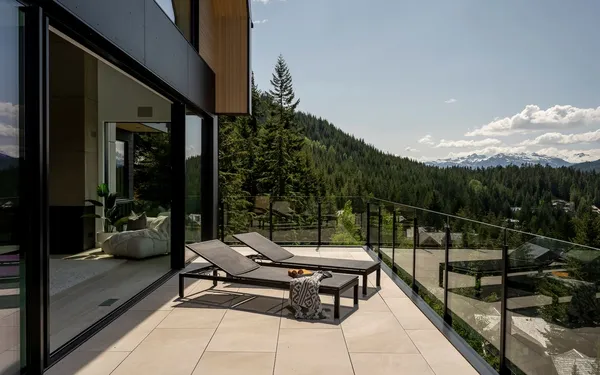
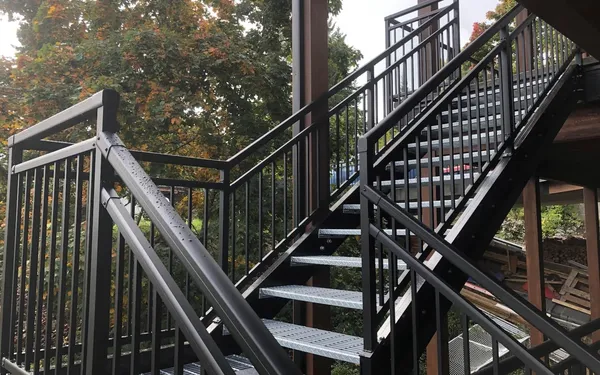
The Powell River, BC project by Modern Powell River is the best example: infinity glass on the main viewing area, picket with colonial top rail on the stairs (because the local municipality required a graspable profile), and privacy picket on the neighbour-facing sections. Three infill types, one colour, one set of hardware. It looks like one design, not three compromises bolted together.
If your budget allows glass on the stairs, go for it. Glass component on stairs looks fantastic and the Gibsons project proves it. But if the budget is tight, putting the glass where you'll actually see it (the deck) and using picket where function matters more than aesthetics (the stairs) is the approach most of our dealers recommend.
Glass stair railing for interior staircases
A significant portion of people searching for glass stair railing are thinking about interior stairs, not exterior deck stairs. Interior glass stair railing is a different installation environment with different considerations.
The structural loads are the same (building codes don't differentiate between interior and exterior guards for load requirements), but the environmental exposure is completely different. Interior glass doesn't face UV, rain, freeze-thaw cycles, or salt air. The powder coating on the aluminum frame lasts effectively forever indoors because there's no weather degradation. The setting blocks and gaskets also last longer without UV exposure.
Interior staircases are where frameless glass stair railing makes the most sense. The controlled environment means post alignment is more predictable (no expansion/contraction from temperature swings), the glass doesn't need to handle wind loads, and the aesthetic impact of frameless glass on an interior staircase is dramatic. Modern residential architecture increasingly uses frameless glass on interior stairs as a design feature, letting light flow between floors.
If you're considering glass stair railing for an interior staircase, talk to your dealer about specifying the right system for indoor conditions. Our systems are engineered for the demands of exterior decks, but they install indoors the same way. We supply interior stair railing projects regularly through our dealer network. The components are the same, but the installation considerations are slightly different.
Code requirements specific to glass stairs
Glass stair railing has to meet all the standard stair code requirements plus glass-specific rules:
Height: 34" to 38" measured from the stair tread nosing (not the tread surface). This is the same for glass and picket.
6-inch sphere rule: The triangle between the bottom rail, the tread nosing, and the riser cannot allow a 6-inch sphere to pass through. The bottom rail of the glass stair system has to sit close enough to each tread nosing to pass this test.
Graspability: Many municipalities require a graspable handrail on stairs. Glass component with a round or colonial top rail meets this. Frameless requires a separate applied handrail.
Tempered glass requirement: All glass used in guards must be tempered (safety glass). Our systems use 6mm tempered glass for component and 12 to 13mm tempered glass for frameless. Both are tested by Intertek per ICC-ES AC273 with a safety factor of 4.0.
Laminated glass on elevated installations: Starting with the 2015 IBC, Section 2407 requires guard glass to be both tempered and laminated in many US jurisdictions. This adds 30 to 50% to the glass panel cost but provides a critical safety advantage: if laminated glass breaks, the interlayer holds the fragments in place instead of dropping shards onto whatever is below. For elevated exterior stairs, laminated glass is worth serious consideration even where code doesn't mandate it.
For the full code picture: Deck Railing Building Code Requirements. For glass panel specifications: Glass Railing Panels.
Ready to explore glass stair railing for your project? Find a dealer who can assess your stair layout and recommend the right system, or try our 3D Railing Designer to visualize different options.
Frequently asked questions
How much does glass stair railing cost?
Glass component stair railing runs $100 to $180 per linear foot installed. Frameless glass on stairs runs $160 to $280+ per foot. The premium over level deck glass is 15% to 40%, driven by custom panel fabrication, two-visit installation, and heavier glass handling on angled surfaces. Most homeowners choose glass on the level deck and picket on the stairs to manage the budget.
Can you use frameless glass railing on stairs?
Yes, but it's uncommon on exterior deck stairs. The post tolerances on angled surfaces are extremely tight, the glass panels are thicker and heavier (12 to 13mm), and most building codes require a graspable handrail that frameless doesn't have. An applied pipe handrail has to be added separately, which increases cost and adds visual complexity. Glass component (framed) is the more practical option for most stair applications.
Is glass stair railing safe?
Yes. Our glass stair railing systems are engineered to meet the National Building Code of Canada 2020 and the US IRC. The tempered glass panels are tested by Intertek per ICC-ES AC273 with a safety factor of 4.0. If tempered glass does break, it fractures into small granular pieces rather than large shards. For elevated stairs, laminated glass (tempered glass with a plastic interlayer) holds fragments in place if broken.
Can I mix glass on the deck with picket on the stairs?
Yes, and it's the most common approach. All Innovative Aluminum systems share the same posts, base plates, and colour palette. Glass on the level deck with picket on the stairs in the same colour looks cohesive. The transition at the sleeve post is clean because the hardware matches across both systems.
Does glass stair railing work indoors?
Yes. Interior staircases are actually where glass stair railing, especially frameless, makes the most sense. The controlled indoor environment means no weather exposure, more predictable post alignment, and no wind loads on the glass. Modern residential architecture increasingly uses frameless glass on interior stairs to let light flow between floors.
What glass thickness is used for stair railing?
Glass component (framed) stair railing uses 6mm tempered glass. Frameless stair railing uses 12 to 13mm tempered glass because the glass has to handle lateral loads without top rail support. Both are tested to the same code requirements. Thicker glass is heavier, more expensive to fabricate, and harder to handle during installation on angled surfaces.