Deck railing building code requirements for Canada and the US — height, spacing, load, climbability, and what inspectors check.
This article is part of our complete Aluminum Deck Railing guide.
We get more questions about building code than about any other topic. Not about our products, not about colours or pricing — code. Homeowners want to know what height their railing needs to be. Contractors want to know if our systems will pass inspection without an argument. Dealers call us from job sites to confirm post spacing for a specific municipality. It's the first conversation on almost every project, and getting it wrong is expensive — not just in fines, but in ripping out finished railing and starting over.
We've been engineering railing systems to the National Building Code of Canada and the US International Residential Code since 2004. Every system we ship from our plant in Aldergrove, BC is certified by JCJ Design Engineering and load-tested by Intertek. When one of our dealers hands an inspector the engineering certification letter that ships with every order, the conversation is usually short. Here's what you need to know so yours is too.
When is a deck railing required?
The threshold is lower than most people think. In Canada, any deck surface more than 600 mm (24 inches) above the ground at any point requires a guardrail on every open side. In the US under the IRC, that threshold is slightly higher at 762 mm (30 inches).
This catches a lot of homeowners off guard. A deck that's only two feet off the ground doesn't feel high — but it's above the code threshold in Canada, and a guardrail is required. We see this regularly on walkout basements where the grade slopes away from the house. The deck might be 18 inches above grade at the door but 30 inches on the far side. That far side needs a guard.
This applies to attached decks, freestanding platforms, balconies, porches, and landings. If your deck sits below the threshold at every single point, you're not required to install a guard — but many homeowners still do for safety, for aesthetics, or because they plan to sell the property and don't want a buyer's inspector flagging it.
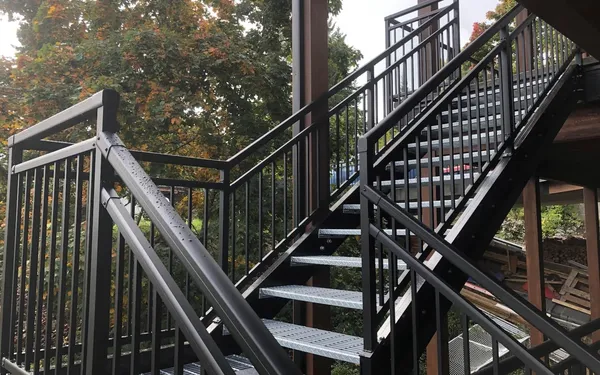
Stairs are separate. In most jurisdictions, any stairway with three or more risers requires a handrail on at least one side, regardless of total height above grade. And stair railing has its own set of rules — different height requirements, different graspability standards, different challenges during construction. We cover the full stair picture in our stair railing guide.
Deck railing height: 36 inches or 42 inches?
This is the question we answer most often, and the answer depends on how high your deck is above the ground. Here's the breakdown by jurisdiction — these are the numbers we engineer every system to.
United States (IRC and IBC)
IRC (residential): guards required when the deck surface is 30 inches or more above grade. Minimum height of 36 inches.
IBC (commercial and multi-family): minimum guard height of 42 inches. This applies to apartment balconies, restaurant patios, commercial rooftops — any occupancy that's not single-family residential. Our systems are engineered to meet these commercial load requirements as well — if you're specifying railing for a multi-family or commercial project, our engineering team can provide project-specific documentation.
Stair handrails: must be between 34 and 38 inches, measured from the stair nosing. Note that a handrail and a guard are different things in code — a guard prevents falls off the side of a deck, while a handrail provides something to grip while using stairs. In most modern aluminum railing systems, these are integrated — the top rail of the stair guard doubles as the graspable handrail. But they're separate concepts in code, and inspectors know the difference.
National Building Code of Canada (NBC 2020)
The NBC follows the same framework. Residential guards on decks up to 1.8 m: 900 mm. Above 1.8 m: 1,070 mm. Stair guards: 900 mm. Each province adopts the NBC with its own amendments, so the local building authority always has the final say — but these numbers are the baseline across the country.
British Columbia (BCBC 2024)
Decks up to 1.8 m above grade: minimum guard height of 900 mm (36 inches).
Decks above 1.8 m above grade: minimum guard height of 1,070 mm (42 inches).
Stair guards: minimum 900 mm (36 inches), measured vertically from the stair nosing to the top of the guard.
Here's something that trips people up in BC: some municipalities enforce stricter standards than the provincial code. Vancouver requires 42 inches on all residential guards regardless of deck height. We've had dealers in Vancouver, West Vancouver, and North Vancouver tell us they've seen inspectors enforce 42-inch minimums on decks that were barely three feet off the ground. If your contractor says 36 inches is fine in the City of Vancouver, double-check with the building department before you order.
| Requirement | Canada (NBC/BCBC) | US (IRC Residential) | |
|---|---|---|---|
| Guard required above | 600 mm (24 in) | 762 mm (30 in) | |
| Standard guard height | 900 mm (36 in) | 914 mm (36 in) | |
| Elevated / commercial | 1,070 mm (42 in) | 1,067 mm (42 in) | |
| Max opening (4-inch rule) | 100 mm (4 in) | 102 mm (4 in) | |
| Stair handrail height | 865–1,070 mm | 864–965 mm (34–38 in) | |
| Horizontal load (guard) | 0.50 kN/m | 200 lbs concentrated | |
| Point load (guard) | 1.0 kN | 200 lbs at any point |
The stair-to-deck transition: where code gets tricky
This is the section most code articles skip, and it's the one that causes the most problems in the field.
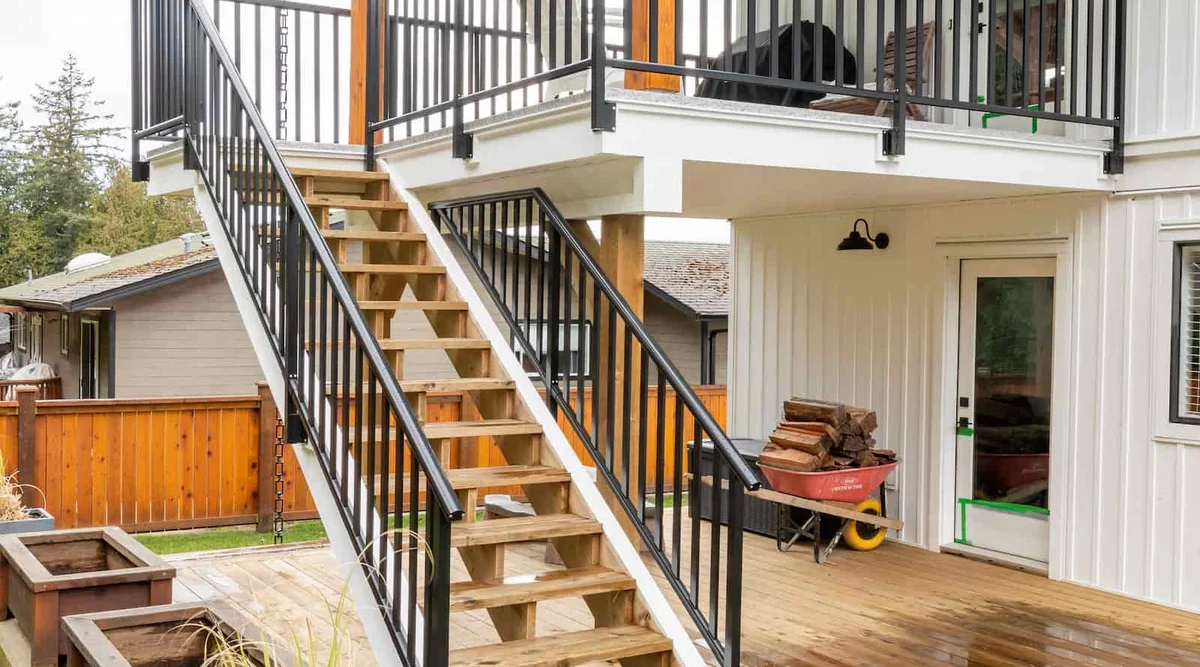
Where a stair section meets the level deck, the railing has to transition from the stair height (typically 36 inches measured from the nosing) to the level deck height (36 or 42 inches measured from the deck surface). On most installations, that's about a 6-inch drop from the level guard down to where the stair guard connects. The transition post — the one at the top of the stairs — is doing double duty, anchoring both sections, and it has to handle the angle change while maintaining code-compliant heights on both sides.
Here's where real-world construction creates a code headache. Builders typically construct the level deck first and leave the stairs until later. The stair stringers, treads, and angle aren't finalized when the railing contractor shows up to measure. So the railing contractor can measure the level sections and order that railing, but the stair sections? They can't order fixed-angle stair railing panels because the stair angle doesn't exist yet. If the manufacturer needs a four-week lead time to build custom-angle stair railing, the project stalls.
This is one of the reasons we developed our Flex Rail system. The stair version uses an articulating sleeve at the top of the stair section — a knuckle-style connection that adjusts to match whatever stair angle the builder ends up building. The bottom rail mounts use a similar articulating system. So the railing contractor can order the stair panels before the stairs are built, then adjust the angle on site during installation. It meets code at any standard stair angle, and it eliminates the lead time problem that causes so many scheduling conflicts between the deck builder and the railing trade.
The cut at the top of the stair rail — where it meets the transition post — varies depending on two things: the stair angle and how far back from the nosing the post base plate is mounted. We're currently building a calculator tool that lets installers punch in their angle and post location to get the exact cut length. In the meantime, our installation guides include reference charts for the most common configurations.
Dealing with stair angles on your next project? See how our Flex Rail system handles field-adjustable stair railing, or talk to our engineering team about your specific layout.
The 4-inch rule: picket and baluster spacing
This is the rule that exists because of children, and it's non-negotiable everywhere. No opening in a guardrail — between pickets, under the bottom rail, between the last picket and the post — should allow a 4-inch (100 mm) sphere to pass through. The sphere approximates the size of a small child's head.
For our aluminum picket railing, this is handled at the factory. The pickets — or "infill," as we call anything that goes between the posts under the rail — are precision-welded at a spacing that meets the 4-inch rule before the system ever leaves Aldergrove. There's no field measurement, no guesswork, no chance of an installer eyeballing the spacing and getting it wrong. When our dealers unbox a panel, the spacing is already code-compliant.
With our Flex Rail insert system, the approach is slightly different. The bottom rail has pre-punched holes and the top rail has an insert channel. Individual pickets snap into position at factory-determined spacing. If the last section of a run doesn't divide evenly, the installer can adjust the end picket position — something you can't do with a welded panel. Either way, the system is designed so that code-compliant spacing is the default, not something the installer has to achieve.
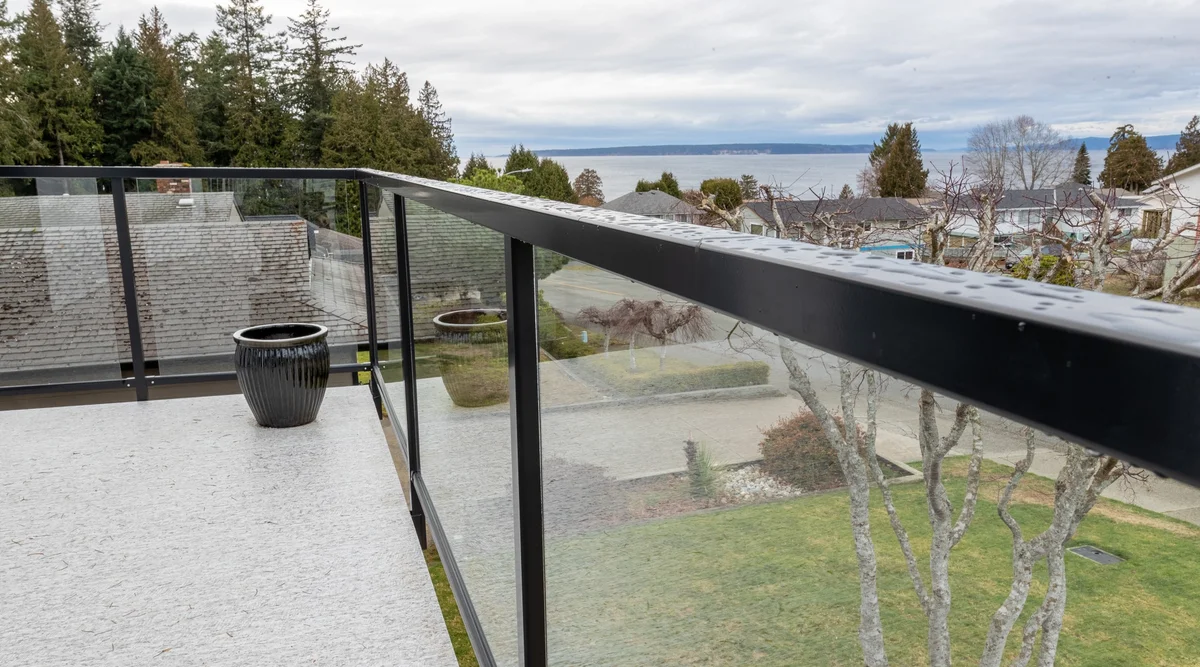
For glass railing systems, the infill is a tempered glass panel that creates a continuous barrier with no gaps to measure. The glass is sized so it can be lifted into the frame — there's enough vertical play at the top for installation, and setting blocks at the bottom support the panel's weight. None of these installation gaps create a code issue because they're within the frame, not exposed openings. The compliance point for glass shifts from spacing to glass quality — it must be tempered or laminated safety glass. Our systems use 6mm tempered glass tested per AC273 with a safety factor of 4.0.
The gap that gets missed most often on inspections isn't between pickets — it's the gap under the bottom rail. If the deck surface is uneven or the bottom rail isn't shimmed correctly, you can end up with more than 4 inches of clearance underneath. Our systems are designed with adjustable bottom rail positioning to account for this, but the installer still needs to verify it at every post bay. We tell our dealers: check the bottom gap at every single post. That's where inspections fail.
Post spacing: how far apart can posts be?
Post spacing isn't specified as a single number in building code — it's determined by the engineering of the specific railing system. Code says the railing has to resist certain loads. How far apart the posts can be while still meeting those loads depends on the post size, wall thickness, mounting method, and what type of infill is between them.
For our systems, the general guidelines from our JCJ Design Engineering certification are:
Picket railing: posts can span up to 6 feet on centre for standard residential applications. The picket infill is lightweight and doesn't add significant wind load, so the posts can be further apart.
Glass component railing: posts can span up to 5 feet on centre. Glass panels are heavier than pickets and create more wind load — they're a solid surface catching wind rather than vertical bars that air passes through. So the posts need to be closer together.
Frameless / topless glass: post spacing depends on the specific wind exposure, glass panel height, and site conditions. Our engineering team calculates this for each project.
These aren't code numbers — they're the engineered capacities of our specific post extrusions. Our posts are extruded from 6005-T61 aluminum with regular wall at 0.070" tested to 315 lbs and heavy wall at 0.235" tested to 555 lbs by Intertek. A competitor's post with a different alloy or wall thickness will have different maximums. This is why "what's the maximum post spacing?" isn't a code question — it's a product question. And the answer should come with an engineering stamp behind it.
One detail worth knowing: on our systems, where posts are located determines where the railing sections join. We call these "sleeve posts" — they're the posts at corners, at the top and bottom of stairs, and wherever two sections of railing meet. The sleeve post has a taller internal mount plate than a standard mid-run post because it needs to capture the rail connections from both sides. Understanding sleeve post locations is the first step in any installation layout, and it's the first thing our installation guides walk through.
Climbability: why horizontal rails can be a problem
Building codes in Canada include provisions to prevent guards from being climbable by young children. The NBC and BCBC specify that no member, attachment, or opening between 140 mm and 900 mm above the deck surface should facilitate climbing. In practical terms, this means horizontal elements in that zone can be a code issue.
Vertical pickets are always acceptable. There's nothing to stand on. This is part of why vertical picket railing remains the standard — it's inherently non-climbable and no inspector will question it.
Horizontal cable railing can be problematic. The cables create evenly spaced footholds. Some provinces and municipalities restrict horizontal cable in residential applications, particularly on elevated decks. We've had dealers tell us about projects where cable railing was installed, failed inspection on climbability, and the homeowner had to pay to replace the entire infill with vertical pickets. If you're considering cable railing, confirm with your local building department before you order — not after.
Glass panels meet climbability requirements inherently — there are no footholds on a flat glass surface. This is one of the underappreciated advantages of glass railing from a code perspective. It's non-climbable, it meets the 4-inch rule automatically (no openings at all), and it provides a continuous barrier. For architects and builders who want a clean path through inspection, glass simplifies the conversation.
Structural load requirements
Your railing doesn't just have to be the right height with the right spacing — it has to be strong enough to stop someone from going through it. Building code specifies minimum loads that every guard must resist.
In Canada (NBC): a horizontal load of 0.50 kN/m applied inward or outward along the top of the guard, plus a concentrated point load of 1.0 kN at any location. For residential applications, this translates to roughly 36 pounds per linear foot of continuous pressure along the top rail, and about 225 pounds at any single point.
In the US (IRC): a concentrated load of 200 pounds applied in any direction at any point along the top of the guard.
These loads matter because they dictate what the railing has to be bolted to. A railing post can be engineered to handle these loads all day — but if it's bolted into a rotting 2x8 rim joist with 2-inch screws, the connection fails before the post does. The railing is only as strong as the weakest point in the system, and that weakest point is almost always the connection to the deck structure.
Our posts are tested by Intertek — regular wall posts handle 315 lbs, heavy wall posts handle 555 lbs, both well exceeding code minimums. But we spend just as much time in our installation documentation specifying the connection details — bolt sizes, blocking requirements, minimum joist dimensions — because that's where failures happen in the real world. Not at the post. At the connection.
Want a railing system that passes inspection the first time? See exactly what's in our engineered systems, or find a dealer who can spec the right configuration for your project.
How material choice affects your inspection
We're an aluminum railing manufacturer, so we're obviously biased. But here's the objective case for why material matters at inspection time:
Aluminum railing systems that are manufactured to code and come with engineering documentation make inspections straightforward. The inspector looks at the system, checks the engineering letter, verifies height and spacing, tests rigidity, and moves on. Our systems ship with a JCJ Design Engineering certification letter that confirms compliance with NBC 2020, BCBC 2024, and several other provincial codes. Our dealers hand that letter to the inspector. It saves time and eliminates arguments.
Glass railing adds a layer. The glass must be tempered or laminated safety glass — the inspector may ask for documentation. For frameless systems, some municipalities require a project-specific engineer's stamp, particularly on elevated decks or high-wind locations. Our Infinity Topless system is engineered and tested, but we still recommend confirming with the local building department before ordering a topless system for any deck above 1.8 m.
Wood railing puts more burden on the builder and the inspector. There's no engineering letter from a factory. The inspector has to visually assess the construction, check every baluster spacing by hand, test the connections, and make a judgment call. Wood also degrades — a wood railing that passes inspection on day one may not meet code five years later when the posts have loosened and the lumber has checked and split.
Vinyl railing meets code when new, but some jurisdictions have concerns about long-term performance in extreme temperatures. Vinyl can become brittle in sustained cold and may warp in heat. Some inspectors require evidence of internal reinforcement — usually aluminum or steel inserts inside the vinyl posts and rails. If you're in a climate with temperature extremes — which covers most of Canada — ask about reinforcement before you buy.
What inspectors are actually checking
We've worked with dealers across Canada and the US for over 20 years. Here's what we consistently hear about what inspectors focus on — and what trips people up.
Guard height. First thing they measure. From the deck surface (or stair nosing) to the top of the railing. If it's short by even a quarter inch, some inspectors will flag it. We manufacture our standard residential systems at exactly 36 inches and 42 inches to eliminate any ambiguity.
The gap under the bottom rail. This is the most common failure point we hear about from our dealer network. The deck surface isn't perfectly flat, or the installer didn't adjust for a slight slope, and there's a 4.5-inch gap under the bottom rail somewhere along the run. A 4-inch sphere fits through. Failed. On every job, the installer should be checking this gap at every post bay — not just eyeballing the first one and assuming the rest match.
Post attachment. Inspectors push and pull on posts. If there's any wobble, they're looking at how the post is connected to the framing. Posts bolted into deck boards only — not into the structural framing or blocking below — will fail. The post base plate needs to connect through the decking into solid framing. Our base plates are 4"x4"x3/8" in 6061-T6 aluminum, designed for through-bolting into structural members.
The stair-to-deck transition. Where a stair section meets the level deck, both the height and the connection matter. The transition post (what we call a sleeve post) is doing double duty — anchoring both the stair railing and the level railing at different heights and angles. Inspectors know this is a structural stress point and they check it specifically.
Documentation. For manufactured systems, inspectors increasingly want to see engineering documentation — not a sales brochure, but an actual engineering letter confirming code compliance from a licensed engineering firm. This is standard with our systems. If you're comparing railing products, ask whether they come with an engineer's certification. If the answer is no, the burden of proof falls on the installer and the inspector, and the conversation gets longer.
A note for our dealers and contractors
If you're an Innovative Aluminum dealer or a contractor installing our systems: the engineering certification letter ships with every order. Keep it on the job site during inspection. If you need additional documentation — wind load calculations for a specific location, a project-specific engineer's stamp for a frameless installation, or confirmation of compliance with a municipal code amendment — contact our engineering team. We do this regularly for dealers across North America. It's part of the service, and it's one of the advantages of buying from a manufacturer that engineers in-house rather than importing parts from overseas.
If you're not yet a dealer and you'd like access to our systems, engineering documentation, and technical support, learn about our dealer program or contact us directly.
Frequently asked questions
How high does a deck railing need to be?
In most of Canada, 36 inches (900 mm) for decks up to 1.8 m above grade, and 42 inches (1,070 mm) above that. In the US, 36 inches for residential under the IRC. Some municipalities like Vancouver enforce 42 inches regardless of deck height. Always confirm with your local building department — they have the final say, and we've seen municipalities enforce stricter standards than the provincial or national code.
What is the 4-inch rule for deck railing?
No opening in a guardrail should allow a 4-inch (100 mm) sphere to pass through. This applies to the gap between pickets, the gap under the bottom rail, and the gap between the last picket and the post. It's a child safety provision and it's consistent across every building code in North America. With manufactured aluminum railing, the picket spacing is set at the factory — it's code-compliant out of the box. The gap to watch for is under the bottom rail, which depends on the deck surface being level at each post location.
How far apart can deck railing posts be?
Post spacing depends on the engineering of the specific railing system, not a single code number. For our aluminum systems, picket railing spans up to 6 feet between posts and glass railing up to 5 feet — based on Intertek load testing of our specific post extrusions (6005-T61 aluminum). A different manufacturer's product will have different engineered maximums. Ask for the engineering documentation before assuming a post spacing is code-compliant.
Does aluminum railing meet building code?
Yes — when it's engineered and manufactured to code standards. Our systems are certified by JCJ Design Engineering to meet the National Building Code of Canada 2020, BCBC 2024, and the US IRC. Every order ships with an engineering certification letter. Not all aluminum railing products carry this level of certification, so ask your supplier what engineering documentation comes with the product.
Do I need a permit for deck railing?
Railing installed on a new deck is typically covered under the deck building permit. If you're replacing railing on an existing deck, some municipalities require a separate permit and some don't. The safest approach is to call your local building department and ask. A five-minute phone call is cheaper than a failed inspection or an after-the-fact permit process.
Is horizontal cable railing allowed?
It depends on the jurisdiction. Some provinces and municipalities restrict horizontal cable railing because the cables can create footholds for children to climb. Vertical pickets and glass panels don't have this issue. If you're considering cable, confirm with your building department before ordering — we've heard from dealers about projects where cable was rejected at inspection and the homeowner had to replace the entire infill at their own expense.
What documentation do I need for a railing inspection?
For manufactured aluminum railing systems, inspectors typically want to see an engineering certification letter confirming the product meets the applicable building code. Our systems ship with a JCJ Design Engineering letter for this purpose. For site-built wood railing, there's no manufacturer documentation — the inspector evaluates the construction visually and through load testing. Having the documentation ready on site saves time and demonstrates that the product was engineered to meet the code the inspector is enforcing.